



Submitting a document in a foreign language to a government agency, court, or university can be a stressful experience. A single error or missing stamp can lead to rejected applications, missed deadlines, and lost money. Many people assume they can simply ask a bilingual friend to translate their paperwork or use a standard online service. Unfortunately, official institutions require a much higher standard of verification.
Understanding the specific requirements of the institution receiving your documents is the most important step in the translation process. Different situations call for completely different approaches to language conversion. You might need a flowing, creative translation for a company brochure, but you will need a strict, legally binding translation for a birth certificate.
This guide explains the exact differences between regular and certified translation. You will learn how each process works, what common use cases look like, and how to choose the right option for your specific paperwork. By the end of this article, you will have the knowledge you need to navigate your next translation project with confidence.
What is Regular Translation?
Regular translation involves converting text from one language to another with a primary focus on readability, tone, and context. The goal is to make the final document sound as natural as possible to the target audience. Translators working on regular projects have the creative freedom to restructure sentences, swap out cultural idioms, and adjust phrasing so the core message resonates perfectly with native speakers.
In this type of translation, strict word-for-word accuracy is less important than the overall flow of the text. For example, a joke that works well in Spanish might make zero sense in English. A regular translator will replace that joke with something culturally equivalent rather than translating the original words literally.
Because regular translation does not require legal validation, anyone with strong bilingual skills can technically perform the job. There is no need for a signed certificate of accuracy, nor does the translator need to prove their credentials to a governing body. The success of a regular translation is measured entirely by how well the target audience understands and engages with the final text.
What is Certified Translation?
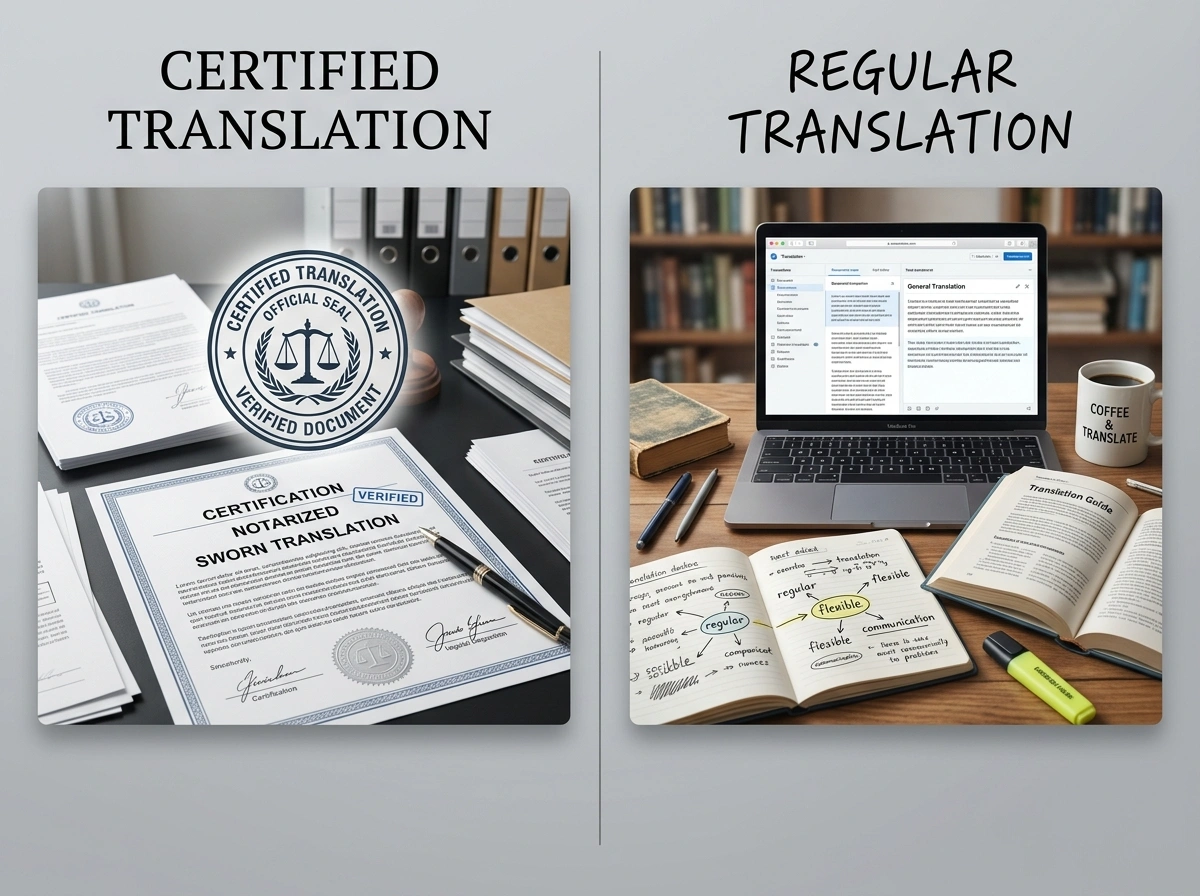
Certified translation is a formal process required for legal, official, and administrative documents. Unlike regular translation, this service includes a signed and dated Certificate of Accuracy from the translator or the translation agency. This certificate acts as a legal guarantee that the translated text is a complete, exact, and accurate rendering of the original source document.
Government agencies, such as the United States Citizenship and Immigration Services (USCIS), mandate certified translations for any foreign-language paperwork submitted with an application. According to USCIS guidelines, the certification must state that the translator is competent to translate the language and that the document is fully accurate. Without this signed statement, your paperwork will be rejected.
Certified translators cannot take creative liberties with the text. They must translate the document word-for-word, matching the exact format, layout, and structure of the original file as closely as possible. If there is a stamp, a signature, or a blurred word on the original page, the translator must note that specific detail in the certified English version.
Key Differences Between Certified and Regular Translation
While both services involve converting language, their methodologies and end goals are vastly different. Understanding these differences helps you avoid costly mistakes.
Accuracy Versus Flow
Regular translation prioritizes the reader’s experience. The translator wants the text to read smoothly, adapting the style to fit the brand or the author’s voice. Certified translation prioritizes legal exactness. The translated document might sound stiff or overly formal to a native speaker, but that rigidity is necessary to reflect the exact legal wording of the original document.
Legal Validity and Documentation
A regular translation is just a piece of text. A certified translation is a legal record. Certified translations always come with a separate certificate page bearing a signature, date, and often a corporate seal or professional membership number (such as an American Translators Association member number). Some institutions also require the certified translation to be notarized, adding a secondary layer of legal authentication.
Formatting Requirements
If you hire a translator for a blog post, they will simply send you a text file. If you hire a translator for a university transcript, they must recreate the visual layout of that transcript. Certified translations mirror the original document’s tables, margins, and seal placements so that an immigration officer or judge can easily compare the source document to the translation side-by-side.
When Do You Need Certified Translation Services?
You will need certified documents whenever you are dealing with a formal institution that requires proof of authenticity. Federal agencies, state courts, medical boards, and academic institutions have strict guidelines regarding foreign-language paperwork.
Immigration is the most common reason people seek these services. If you are applying for a U.S. green card, a visa, or citizenship, you must provide certified translations for birth certificates, marriage licenses, and police records. USCIS will not accept a regular translation under any circumstances.
Legal proceedings also demand high levels of authentication. If you are presenting evidence in a family court, submitting a foreign business contract in a civil lawsuit, or filing a divorce decree from another country, the court will demand certified accuracy.
Academic admissions offices require certified transcripts and diplomas to evaluate foreign educational credentials. Furthermore, if you are transferring an international driver’s license at the DMV, you will need a certified translation of your current license.
To ensure your documents meet all strict federal and institutional guidelines, you can rely on professional certified translation services to handle your paperwork securely and accurately.
The Certification Process: What It Entails
Getting a document certified is a highly structured process designed to eliminate errors and maintain legal integrity. Here is a breakdown of how professional translation agencies handle these requests.
1. Document Submission and Review
The process begins when you submit a clear scan, photo, or PDF of your original document to the agency. The translation team reviews the file to identify the language, the document type, and any illegible sections. They will also note any stamps, seals, or handwritten notes that require translation.
2. Word-for-Word Translation
A qualified, native-speaking translator meticulously converts the text into the target language. They do not summarize paragraphs or skip over boilerplate legal text. Every single word on the page is translated, and the layout is adjusted to visually match the original document.
3. Quality Assurance and Certification
Once the translation is complete, a second set of eyes often reviews the document for accuracy. The agency then generates a Certificate of Accuracy. This document includes a statement of the translator’s qualifications, a declaration that the translation is complete and accurate, the date, and a signature.
4. Optional Notarization or Apostille
Depending on your specific needs, the agency might take the document to a Notary Public. The notary verifies the identity of the person signing the Certificate of Accuracy and stamps the document. If the document is going to be used internationally, the agency might also help secure an Apostille, which authenticates the document for use in countries under the Hague Convention.
Common Use Cases for Regular Translation
Regular translation is the backbone of global communication, business expansion, and media consumption. It is the correct choice when your goal is to inform, persuade, or entertain a foreign audience.
Marketing and Advertising
When taking a business international, companies need regular translation for their marketing materials. A marketing translator will adapt slogans, ad copy, and social media posts so they resonate culturally with the new target market. This process, often called transcreation, requires heavy creative adaptation.
Website Localization
Translating a website requires adjusting the language so users feel completely at home. Regular translation allows you to modify navigation menus, blog posts, and product descriptions to suit the reading habits of the local demographic.
Books, Articles, and Entertainment
Publishers and media companies use regular translation for novels, news articles, video game scripts, and movie subtitles. The priority here is capturing the emotion, humor, and narrative voice of the original creator.
Choosing the Right Service for Your Needs
Selecting the appropriate translation method comes down to identifying the end user of your document. Ask yourself who will be reading the final text and what their expectations are.
If you are submitting paperwork to a government employee, a judge, a university admissions officer, or a medical board, you must use certified translation. Attempting to save money by using a regular translator for official documents will result in immediate rejection, costing you valuable time and application fees.
If you are publishing a document for customers, employees, or the general public, regular translation is the better choice. A certified translation of a marketing brochure would sound unnatural and robotic. A regular translator will ensure your brand voice shines through clearly in the new language.
Always check the specific guidelines of the institution requesting your documents before placing an order. Many government websites provide a checklist detailing exactly what kind of certification they require, including rules about notarization and physical mailing versus digital uploads.
Ensuring Compliance and Quality
Navigating foreign language requirements does not have to be an overwhelming hurdle. By understanding the distinct purposes of regular and certified translation, you can easily avoid bureaucratic delays and communicate effectively across borders.
Take a moment to review the application guidelines for your specific situation. If your documents require a Certificate of Accuracy, seek out a professional agency with a proven track record of USCIS and court compliance. Secure your certified translations early in your application process to ensure a smooth, stress-free submission.
