



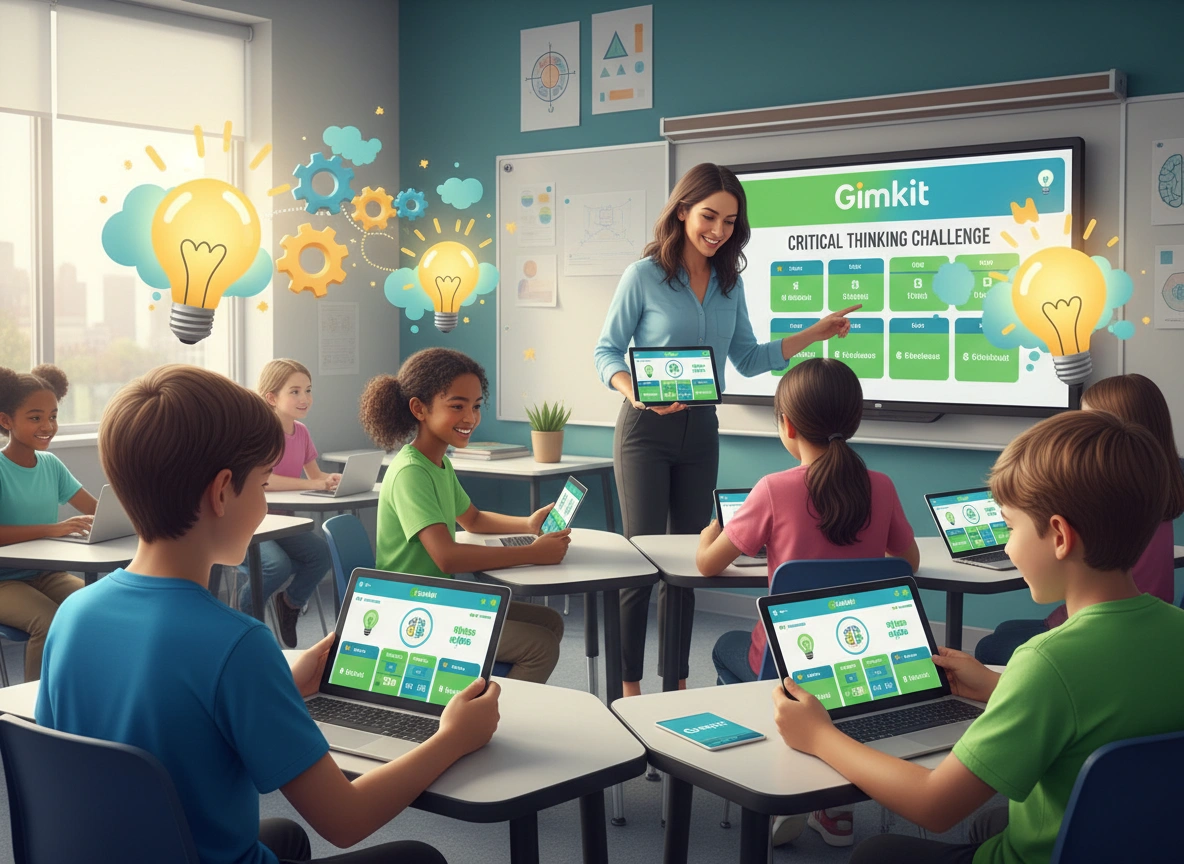
Gamification in education is more than just making learning fun; it’s about creating engaging environments where students can develop essential skills. Among the array of digital tools available to educators, Gimkit stands out for its unique potential to foster critical thinking. While often celebrated for its fast-paced, quiz-show-style gameplay, Gimkit’s features can be strategically leveraged to move students beyond simple recall and toward deeper analytical reasoning. This guide explores how you can use Gimkit to teach and reinforce critical thinking skills in your classroom.
We will cover practical strategies for designing games that encourage problem-solving, analysis, and strategic decision-making. You will learn how to structure questions, utilize different game modes, and facilitate post-game discussions that transform a simple review session into a powerful learning experience. By the end, you will have a clear roadmap for integrating Gimkit into your lessons to help students become more thoughtful and analytical learners.
Beyond Memorization: What is Critical Thinking?
Before we explore Gimkit’s role, it’s important to define what we mean by critical thinking. It is the intellectually disciplined process of actively and skillfully conceptualizing, applying, analyzing, synthesizing, and evaluating information. It’s not just about knowing facts; it’s about knowing what to do with them.
Key components of critical thinking include:
- Analysis: Breaking down information into its component parts to explore relationships.
- Evaluation: Assessing the credibility, relevance, and importance of information.
- Inference: Drawing reasonable conclusions based on evidence and reasoning.
- Problem-Solving: Identifying issues and developing effective solutions.
- Communication: Articulating thoughts and ideas clearly and persuasively.
A tool like Gimkit, when used with intention, can touch upon all these areas, pushing students to think strategically and make informed decisions under pressure.
Strategies for Building Critical Thinking with Gimkit
Transforming a Gimkit session from a simple quiz into a critical thinking exercise requires thoughtful design. It begins with the questions you ask and extends to the game mode you select and the way you frame the activity.
Crafting Questions That Promote Deeper Thought
The foundation of a thought-provoking Gimkit is the quality of its questions. Move away from basic recall and design questions that challenge students to analyze, evaluate, and apply their knowledge.
Scenario-Based Questions
Instead of asking for a definition, present a short scenario where students must apply a concept. This requires them to understand the “why” and “how” behind the facts.
- Weak Question: What is the definition of photosynthesis?
- Stronger Question: A plant is placed in a sealed container with no light but plenty of water and CO2. What will happen to the plant over the next week and why?
Cause and Effect Analysis
Structure questions that ask students to identify the relationship between events or ideas. This encourages them to think about consequences and connections.
- Weak Question: Who signed the Declaration of Independence?
- Stronger Question: Which of the following events was the most direct cause of the American colonies declaring independence from Britain?
Compare and Contrast
Ask students to evaluate two or more concepts, characters, or historical events. This pushes them beyond surface-level understanding to identify subtle similarities and differences.
- Weak Question: What are the characteristics of a mammal?
- Stronger Question: A bat and a penguin both have wings, but only one is a mammal. Which of the following best explains this distinction?
Leveraging Game Modes for Strategic Gameplay
Gimkit offers several game modes, each with unique mechanics that can be used to develop different aspects of critical thinking. While classic mode is great for review, other modes introduce strategic layers.
Trust No One: Fostering Evaluation and Deduction
This “imposter” style game is perhaps the most direct way to teach critical thinking with Gimkit. Students must use deductive reasoning and evaluate the answers and behaviors of their peers to identify the imposters.
- Implementation: Before the game, review the concepts of evidence and inference. Encourage students to pay attention to incorrect answers and suspicious voting patterns.
- Post-Game Discussion: Lead a debrief where students explain their reasoning for suspecting certain players. Ask questions like, “What evidence led you to believe they were an imposter?” or “Was there a specific answer that made you suspicious?” This meta-cognitive reflection is crucial.
The Floor is Lava: Encouraging Collaboration and Prioritization
In this team-based mode, the entire class works together to survive. Success depends on communication and strategic resource management. Teams must decide which power-ups to buy and which players need support.
- Implementation: Divide students into teams and assign roles (e.g., resource manager, researcher). Challenge them to develop a team strategy before the game begins.
- Critical Thinking in Action: Students must constantly evaluate the team’s position. Is it better to spend money on shields or to help a teammate who is falling behind? This requires problem-solving and prioritizing group success over individual gain.
Humans vs. Zombies: Promoting Long-Term Strategy
This game mode requires students to think about both short-term survival and long-term objectives. As a human, you must balance earning money with buying power-ups to defend against zombies. As a zombie, you must coordinate attacks.
- Implementation: Use this mode for complex topics where students need to make layered decisions. The pressure of an approaching “zombie” forces quick, analytical thinking.
- Strategic Nuance: Ask students to consider opportunity cost. Is it worth answering one more question for a small cash reward if it leaves them vulnerable to a zombie attack? This mirrors real-world decision-making.
Facilitating Post-Game Reflection
The learning doesn’t stop when the game ends. A facilitated discussion is where you can solidify the critical thinking skills practiced during the game. This is your opportunity to connect gameplay decisions to academic concepts and real-world problem-solving.
Guiding Questions for Deeper Learning
Use open-ended questions to prompt students to reflect on their thought processes.
- “Describe a moment in the game where you had to make a difficult choice. What was your reasoning?”
- “Which question was the most challenging and why? What information did you need to answer it correctly?”
- “If we played again, what would your strategy be and why would you change it?”
- (For team games) “How did your team communicate to make decisions? What worked well, and what could be improved?”
By verbalizing their strategies, students engage in metacognition, or “thinking about their thinking.” This practice is fundamental to improving their ability to analyze problems and evaluate solutions in any context.
Benefits of Using Gimkit for Critical Thinking
Integrating Gimkit with a focus on critical thinking offers several advantages over traditional teaching methods.
- Increased Engagement: The gamified environment motivates students to engage with complex material. The desire to win drives them to think more deeply about the questions and strategies.
- Safe Space for Failure: Gimkit allows students to make mistakes and learn from them in a low-stakes environment. An incorrect answer or a failed strategy in a game is a learning opportunity, not a failing grade.
- Development of Soft Skills: Beyond academic knowledge, students practice collaboration, communication, and strategic planning—skills that are highly valued in higher education and the modern workforce.
- Immediate Feedback: The platform provides instant feedback on answers, while the game dynamics offer immediate feedback on strategic decisions. This rapid cycle of action and consequence helps students adapt and refine their thinking in real time.
Conclusion: Playing with a Purpose
Gimkit is a powerful tool that can be so much more than a fun Friday review activity. By intentionally designing your questions, selecting strategic game modes, and facilitating thoughtful post-game discussions, you can transform it into a dynamic arena for developing critical thinking skills.
Start by modifying one of your existing question sets to include more analytical or scenario-based questions. Experiment with a new game mode like “Trust No One” and dedicate time for a debrief. As you integrate these strategies, you empower your students to not only learn the curriculum but also to analyze, evaluate, and solve problems—preparing them for success far beyond the classroom.
